
What is Mixed Reality?
CGI Visualization to Perfection
Danthree Studio turns complex 3D tech into high-converting marketing assets. Get high-end quality for your brand.
Discuss your projectWhat is Mixed Reality?
What is Mixed Reality (MR)?
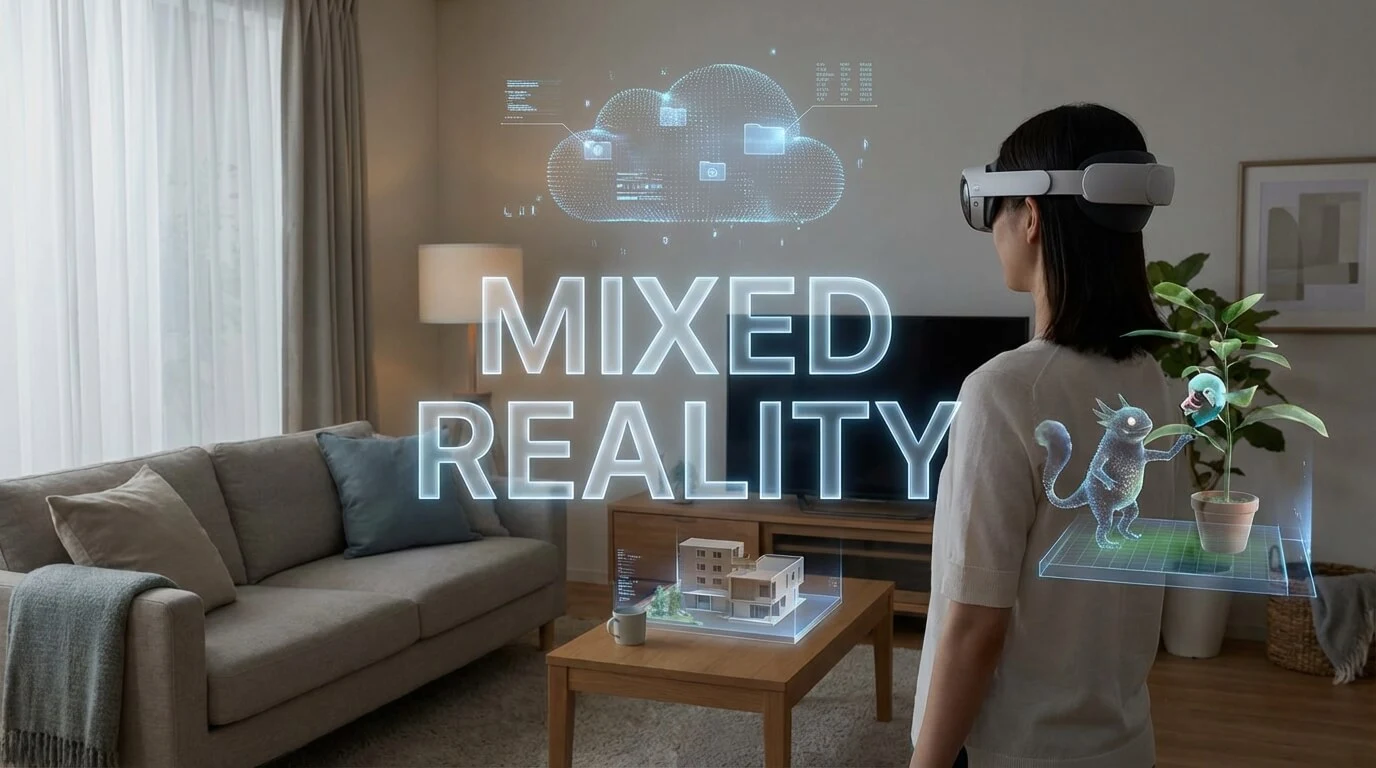
Mixed reality is the real-time fusion of the physical and digital worlds. Virtual 3D objects are not merely superimposed onto the camera image (as in augmented reality), but also understand the space, lighting, and physics of the environment. The result: Digital content reacts realistically to furniture, walls, or user movements, making it seem tangible.
How does mixed reality work?
Definition:
- AR superimposes digital objects onto the real world
- VR completely replaces the real world.
- MR combines both and allows virtual elements to interact with the real world.

From Technical Term to Visual Experience
We don't just use these technologies; we master them. See how we create photorealistic worlds for leading brands.
View WorkAdvantages for furniture & interior brands
In-Store Product Experience
Customers place a sofa in their actual living room and check the dimensions and fabric—this lowers the barrier to purchase.
Interactive Brand Spaces
MR showrooms combine an authentic in-person atmosphere with digital storytelling elements—ideal for trade shows.
Cost and Time Savings
No setup of sample living room sets; updates are made centrally in the MR app.
Omnichannel Synergy
The same 3D asset is used for MR presentations, 3D virtual showrooms, and web viewers.
Typical Applications
1. Configurator 2.0 – Change colors, fronts, and handles in real time.
2. In-store consultation – The salesperson displays the MR version right next to actual samples.
3. Remote Sales – Field sales representatives share an MR session via Holo-Call; customers see the furniture in their own room.
4. Product Training – Technical components can be disassembled virtually; ideal for assembly training.
Workflow at Danthree
Step 1 -> CAD import & 3D modeling - optimization for real-time performance.
Step 2 -> PBR material setup - Metalness, Roughness and Normal maps.
Step 3 -> Baking & LODs - Lightmaps, Texture Baking and Level-of-Detail for mobile hardware.
Step 4 -> MR integration - Deployment in Unreal, Unity or Dynamic 365 Guides.
Step 5 -> Testing & Analytics - Evaluate user paths, iterate KPIs.
FAQ - Mixed Reality
Is mixed reality possible without a headset?
Yes, newer iPad Pro models & Android devices with LiDAR/ToF support basic MR via camera image.
Which data formats are suitable?
glTF/GLB (real-time) and USDZ (Apple) are efficient. Both formats consistently support PBR materials.
Just how performance-hungry is MR?
A clean mesh topology, instanced UV mapping, and occlusion culling keep the FPS stable.
Do I need special rendering engines?
Most MR frameworks are based on Unreal or Unity—they run the same shaders as in traditional rendering pipelines.
How much does an MR project cost?
The range extends from 5 figures (a single product, light occlusion) to 6 figures (a complex multi-room showroom). We provide transparent quotes upon request.
Which headsets support mixed reality (as of 2025)?
- Apple Vision Pro – focuses on “spatial computing” and blends apps with the environment.
- Microsoft HoloLens 2 – Part of Azure Mixed Reality Services.
- Meta Quest 3 – Consumer headset with color transparency.
- XREAL Air 2 Ultra – lightweight glasses for mobile MR apps.
Do I absolutely need a headset—or can I use MR on a tablet or phone?
A head-mounted display is ideal for full-fledged hand and room interaction. However, LiDAR iPad Pro models show simple MR overlays - see Apple's overview of augmented reality on iPhone & iPad.
Which cloud services facilitate scaling & collaboration?
- Azure Remote Rendering & Object Anchors stream high-poly CAD in MR.
- VisionOS CloudKit synchronizes MR sessions across Apple devices.
- Autodesk XR Services enable model reviews directly from Revit or Fusion 360.
Which authoring tools do I use for materials & assets?
PBR textures with Adobe Substance 3D & Mixed Reality can be exported as glTF / USD to Unreal or Unity.
Which real-time framework will be state-of-the-art in 2025?
Unreal Engine XR dominates high-fidelity MR (Lumen GI, Path Tracer). Unity remains more streamlined on mobile but is losing market share in the high-end segment.
XR, AR, MR—what's the difference?
According to Wikipedia’s entry on “Mixed Reality,” XR (Extended Reality) is the umbrella term for AR (real world + overlay) and MR (real world + digital elements with spatial awareness). Some Autodesk white papers use XR interchangeably with MR; technically, MR remains the more precise term.
How do I integrate mixed reality into my existing 3D pipeline?
- Asset optimization - reduced poly counts & LODs.
- Material Conversion – PBR Maps to glTF / USDZ.
- Deployment – Build for Unreal XR or Unity URP.
- Analytics - Heatmaps & session logs for KPI measurement.
Tip: Rendering takes place in a render engine that handles real-time shading and occlusion culling.