Executive Summary
The use of public AI tools poses significant risks to premium brands in terms of data protection and copyright. Those who upload sensitive CAD or product data to open-source tools often lose rights to their own images and feed third-party training models. The secure alternative: a closed, hybrid workflow that combines 100% physically accurate CGI models with isolated, local AI instances. This ensures Brand Safety, legal certainty, and unlimited scalability for your visual marketing.
The marketing floors of global premium brands and medium-sized hidden champions are currently facing a dilemma. On the one hand, generative AI offers unprecedented speed in content production. On the other hand, legal departments and IT security are sounding the alarm. And rightly so. Because anyone who blindly uses public AI tools for their campaigns today is playing Russian roulette. It's not just about copyright, but also about the security of your most sensitive data and design secrets.
The questions that we at Danthree Studio discuss in conversations with brand managers and C-level executives now go far beyond visuals. Who owns the image? And even more controversial is the question of what happens to the images of a secret prototype that are uploaded to the AI.
The answer does not lie in rejecting the technology, but in a closed and professional infrastructure. We need to move away from naive prompting on public servers towards a controlled symbiosis of CGI and local AI instances. This is exactly where our AI-based content scaling comes in, combining security and efficiency for high-end requirements.
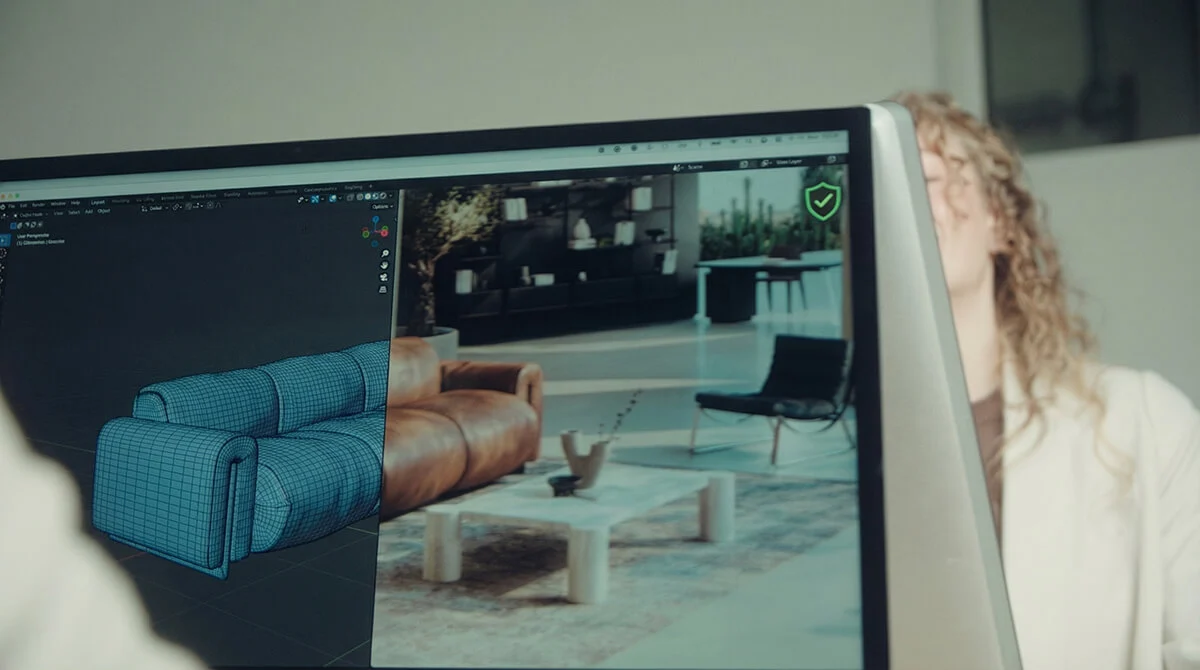
The hybrid workflow in action: Using complex node pipelines, we combine the precision of 3D rendering with the creativity of AI—while maintaining full control over the result.
The data leak: when your product becomes a training mass
An often underestimated risk with common web AI tools is the use of input data. Many terms of use of large AI providers allow them to use the uploaded images and the generated results to improve their models. Well-known companies such as Samsung have already restricted the use of ChatGPT after sensitive data was leaked through the use of public AI tools.
This is a nightmare for a premium brand. You upload renderings of an unreleased product to quickly test different backgrounds. These images flow into the AI's training data set. Theoretically, the AI could learn these design features and later reproduce them in the results of other users or possibly your competitors. Or worse still, the data could be stored on servers outside of your control, triggering massive conflicts with confidentiality agreements and GDPR regulations.
Genuine Brand Safety AI therefore primarily means data sovereignty. We therefore work in closed systems in which your data does not leave the studio and is not used to train public models.
Strategic compass: When high-end CGI? When hybrid AI?
To avoid misunderstandings: We are not a pure AI agency that generates random images at the push of a button. We are technical artists for the premium sector. For us, AI is a tool for scaling, but never a substitute for precision craftsmanship. For premium brands, it's not the channel that matters, but the goal of the content:
1. classic high-end CGI (the visual anchor)
This is essential for your hero assets and the definition of your visual language.
- Use: Main catalog, website, print campaigns, but also as key visuals on social media.
- Why CGI: Here you need 100% control over every light reflection, physically correct fabric folds and extremely high resolutions. The product must be the absolute star, without compromise. Pure manual work and 3D modeling are required here to stage the brand perfectly.
The human eye makes the difference: High-end CGI is digital craftsmanship to ensure the quality of your brand without compromise.
2. the hybrid AI workflow (intelligent scaling)
This is the solution for content depth and variance.
- Use: Storytelling on social media, seasonal adjustments (e.g. winter mood for the existing summer image), A/B testing of backgrounds, newsletter headers.
- Why hybrid: High-end quality is also a must on social media. But the frequency requires more than just a single motif. Instead of building a completely new 3D scenario for every Instagram story, we use the perfect CGI rendering as a basis and generate atmospheric variants using AI. This turns a high-end CGI asset into an entire campaign - efficiently, safely and without any loss of product quality.
The risk of randomness: Why pure AI dilutes brand DNA
If you don't make this distinction and rely purely on text-to-image generators for the main motifs, you are letting the design out of your hands. An AI does not understand your product, it calculates probabilities. If you request an image of a minimalist high-end loudspeaker, you will receive the visual average of all loudspeakers with which the model was trained.
For a manufacturer who has invested months in industrial design, this is unacceptable. If the AI misinterprets materials or distorts proportions, you dilute your brand. Premium customers don't buy probabilities, they buy precise design.
The legal loophole: Copyright for product visuals from AI
Added to this is the legal uncertainty surrounding the output. In recent decisions on AI works, the US Copyright Office has made it clear that purely AI-generated images without significant human creativity often do not enjoy copyright protection. In the worst case scenario, this means that your competitors could legally copy your AI-generated marketing images.
Copyright in AI images is a minefield as long as the human spark is missing. A mere prompt is often not enough to justify this protection. The situation is different if the basis of the image is based on your own proprietary design data.
| Publicly available AI tools (e.g., Midjourney, ChatGPT) |
Closed Hybrid Workflow (Danthree) |
Privacy & Data Breaches
- User input and images are often incorporated into the providers' public training materials.
- High risk of unpublished product designs being leaked.
|
Privacy & Data Breaches
- Isolated infrastructure: Local instances and strict NDAs guarantee 100% data security.
- No disclosure of design secrets to third-party AI systems.
|
Copyright & Brand Safety
- Outputs are often not legally protected (no human authorship).
- AI hallucinates about proportions, seam allowances, and fabric textures. The brand's DNA gets watered down.
|
Copyright & Brand Safety
- Legal certainty: Based on CGI models created by humans, with clear usage rights.
- With millimeter precision: The CGI twin remains unchanged as the base model; the AI simply scales the environment.
|
The solution: the Digital Twin as a security anchor
To ensure data protection and copyright, we turn the process around. We don't let the AI guess what your product looks like. We tell it what it should look like, in a controlled environment.
We use a Digital Twin, the exact 3D replica of your product, as an irrefutable basis. The 3D model is your intellectual creation, based on your CAD data. It is protected by copyright.
The process at Danthree is hybrid and secure. We create the product classically in 3D, whereby the geometry and texture are 100% correct. We then use AI tools that run on our own servers or in isolated cloud instances. There is no data transfer to public training pools. In addition, we train our own small models exactly to your design language. These models belong to you and are not accessible to anyone else.
AI training with your own data: Tech-Enabled Craftsmanship
This approach is AI training with your own data in its purest form, but secure. The neural network learns your specific corporate identity without the global public having access to it. This is particularly important for complex materials and surfaces, which are often misrepresented in standard AI.
When we combine this trained data with the geometric precision of CGI, we get the physical correctness and legal certainty of classic CGI as well as the data protection guarantee that your design will not become public property.
Conclusion: control is the new currency
In a world where anyone can generate images, quality, legal certainty and data protection become the key differentiators. Say goodbye to the idea that public AI tools are a shortcut to professional marketing. They are a tool that can only be used safely in a secure infrastructure.
The path is clear for brand manufacturers. Maintain sovereignty over your data. Use high-end CGI for the product and secure AI workflows for emotion and scaling. This not only secures your copyright, but also protects your trade secrets.
Exclusive for Premium Brands
Protect your brand DNA. Scale without risk.
Don’t compromise on copyright or data protection. Danthree Studio implements a 100% secure, hybrid content workflow for your furniture or tech brand—from CAD files to photorealistic digital brand spaces.
Schedule a strategy meeting

Daniel Schuster
Founder, Master Carpenter & Creative Technologist
“Anyone who carelessly uploads their unfinished product designs to public AI models is playing Russian roulette with their intellectual property.”
As a master carpenter and creative technologist, Daniel understands the true value of product design. Through Danthree Studio, he advises global premium brands on building secure, hybrid CGI pipelines that enable scalability without compromising copyright or data privacy.
Connect on LinkedIn