Executive Summary
Two client conversations about AI labeling lead to a different question: does the image show the actual product? In CGI production, product data and comparison with physical samples make the representation checkable. AI can support backgrounds and image variations. Approval depends on the product details, whatever methods were used.
Two conversations with premium brands stayed with me that week. Both wanted to keep AI out of their product imagery, independently citing the label they believed it would require. I am not assessing whether that interpretation applies to their images. Two conversations do not establish a market trend. They do raise a useful question: what does a customer think when an image of a sofa carries an ‘AI-generated’ label?
My assumption is that the customer is more likely to question what the sofa really looks like than to think about the technology. Our conversations do not prove that response. But it is worth considering, especially when an image appears in a campaign or a design magazine. A brand is asking for more than attention there. It is asking someone to form an expectation of the product.
I have a stake in this as the founder of a CGI studio. We create product imagery and environments for brands, and we also use AI for backgrounds and image variations. For us, the useful distinction is not simply whether AI was involved. It is whether the depicted product can be checked against its references or merely looks plausible.
Article 50 provides context, not a measure of image accuracy
The transparency provisions in Article 50 of the EU AI Act generally apply from August 2, 2026. The European Commission published its final guidelines on July 20, 2026. Its overview of Article 50 explains the scope. The rules distinguish between different obligations and include transition provisions. This article does not determine what labeling any particular image requires. Our focus here is what the image tells someone about the product.
A look at a node-based workflow: connected processing steps move image information through the pipeline. The interface alone does not demonstrate a particular level of data security.
Confidential product data: what happens when you upload it to AI?
Not every cloud service uses inputs for training. The specific product, settings, and contract terms matter. For example, OpenAI does not train on business and API data by default. That is not a blanket approval to upload confidential product data.
Before uploading, establish who can access the data, where it is processed, how long it is retained, and whether training is allowed. For unreleased products, those terms must fit your confidentiality obligations. If the files contain personal data, the legal basis for processing also needs review.
Brand safety for AI product imagery involves separate checks: data handling, rights, and how your brand is represented. Local processing or an NDA may form part of the approach. Neither guarantees complete security on its own.
Check the product. Art-direct its setting.
A photograph is staged, lit, and retouched. A CGI scene is built. Both are constructed images. What matters to us is whether the representation can be traced to the actual product and checked against its specifications. Neither photography nor rendering proves that on its own.
1. CGI as an editable product foundation
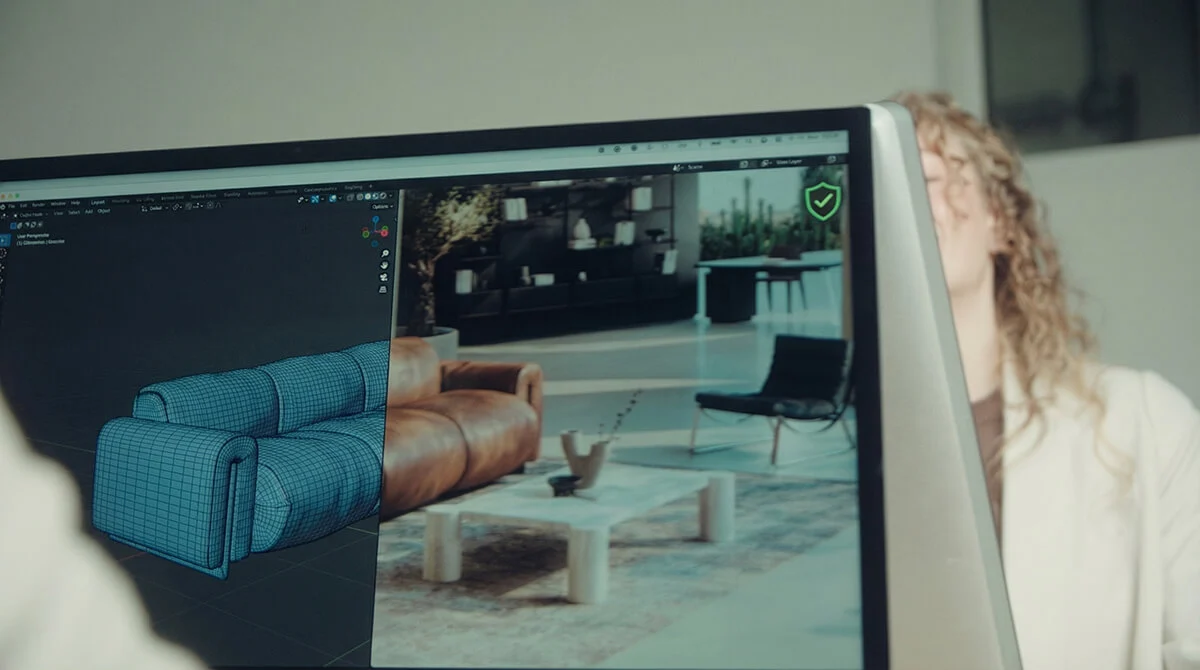
For our 3D product visualization, we work from the manufacturer's CAD data when available and review shape and materials against the agreed references. We examine a physical sample in daylight. That gives us a basis for discussing a seam, the direction of wood grain, or the appearance of a fabric. It does not make us infallible. It makes our work checkable.
- Uses: Main catalog, website, print campaigns, as well as key visuals on social media.
- Why CGI: Geometry, materials, lighting, and camera position can be adjusted deliberately. During 3D modeling and image review, we compare the representation with your product data and material references. Resolution follows the intended output format.
Two Danthree Studio team members review a product visualization on a monitor.
2. Hybrid image production with CGI and AI
We use AI for tasks such as backgrounds and variations of an existing image. The product remains part of the approval process. Even when only the setting is meant to change, we check whether edges, proportions, materials, or details have changed with it.
- Uses: Storytelling on social media, seasonal adjustments (e.g., adding a winter vibe to an existing summer image), A/B testing of backgrounds, newsletter headers.
- Why hybrid: AI can help vary backgrounds or atmosphere. Whether that is preferable to a new 3D scene depends on the image, number of variations, and retouching required. These versions also need a product-detail and visual-language review before approval.
AI product images: likeness is not the same as accuracy
A generative image model produces a plausible representation from learned patterns and the instructions it receives. Reference images, masks, and other controls can constrain the result. They do not automatically turn it into a geometrically defined product model. A convincing sofa may still have a different seam, an altered leg, or a fabric that does not exist in the collection.
So we look beyond the overall impression. We review the features that define the product: dimensions and proportions, materials, stitching, connections, or controls. Missing information needs to be clarified. A deviation can then be discussed against a known specification and corrected. A description of how the image was made cannot replace that comparison.
Fabric and upholstery in detail: a CGI image from our Kvadrat Textiles on chairs project.
AI product image copyright: what CGI does not solve automatically
For brands working across markets, the legal context matters. In Germany, Section 2 of the Copyright Act requires a personal intellectual creation. In the United States, the Copyright Office focuses on human creative contributions; prompts alone are not sufficient in its assessment. Using AI as a tool does not, however, automatically exclude protection for human-authored contributions.
Owning a CAD file therefore does not automatically establish copyright in the finished image. Address rights to source material, human creative contributions, and deliverables separately. A lack of protection for individual AI-generated elements is not a general license to copy someone else’s product image. Get qualified advice on the specific legal position.
| Clarify before use |
Agree for production |
Privacy & Data Breaches
- Will your inputs be used for training? Check the product, settings, and contract.
- Who can access the data, where is it processed, and when is it deleted?
|
Privacy & Data Breaches
- Data processing: Record permitted services, access, and retention.
- Agree on confidentiality requirements before sharing unreleased designs.
|
Copyright & Brand Safety
- Which human creative contributions does the image contain? What rights cover the source material?
- Which form, material, and brand details must remain consistent across variations?
|
Copyright & Brand Safety
- Usage rights: Define deliverables, permitted use, and handover in the proposal.
- Image approval: Compare each variation with approved product and material references.
|
From the product model to a setting for the brand
A digital twin for visualization makes the product's form and materials editable in 3D. Choosing the other pieces in the room, deciding how light enters, and leaving certain things out is the other half of the work. People make those decisions. They determine whether an environment belongs to your brand or could belong to anyone.
We model and texture from agreed product data and material references. CAD files help when available; otherwise, we build a model from sufficient dimensions and product information. We do not deliver manufacturing-ready engineering data.
Before adding AI, we agree on permitted processing steps and services. Each variation then needs a review of form, details, and materials. Whether the deliverables include 3D scenes, models, or finished images only is defined in the proposal alongside usage rights.
AI training on your own data: what to agree first
Project-specific AI training is a separate scope of work. It requires suitable data and the necessary usage rights. If planned, access, permitted uses, retention, and any model handover must be explicitly agreed. A trained model does not automatically belong to the client.
For material and surface visualization, physical references and visual review remain essential. Scans or training data alone guarantee neither an accurate depiction nor particular usage rights.
What you can explain to your customers about the image
The useful claim is not that a particular technology cannot make mistakes. You can explain which product data informed the image, what it was compared with, and who approved it. Whether photographed, rendered, or supported by AI, that traceability says more than a general promise of quality.
Data handling and usage rights remain separate questions. For image production, the conversation starts with your product, its reference material, and your brand's visual language. Those determine where CGI is needed and where AI can contribute. This article presents our production perspective. It is not legal advice.
Product and visual direction
What does your image need to show?
Tell us about the product and the image you have in mind. We can discuss the available reference material, the visual direction, and the details you need to review before approval.
Discuss your imagery

Daniel Schuster
Founder, Master Carpenter & Creative Technologist
Product understanding as the foundation of image production.
Daniel Schuster is the founder of Danthree Studio and a master cabinetmaker. At the studio, he brings an understanding of materials and form to CGI for furniture, home and living, and technology brands.
Connect on LinkedIn